


Titanium Forged Ring
Baoji Wantaida Titanium Material Co., Ltd. is located in Baoji in western China, a non-ferrous metal processing and sales of high-tech enterprises. The company focuses on the production and sales of titanium, zirconium, tantalum, nickel, tungsten, molybdenum and other non-ferrous metal materials. The products are exported to the United States, Britain, Germany, Italy, Japan, South Korea, Canada, Australia, Chile and other countries, well received by customers.
Why Choose Us?
High quality
Each batch of goods has a corresponding quality inspection report to solve your concerns about product quality.
Professional solution
With rich experience and one-to-one service, we can help you choose products and answer technical questions.
Good services
Customer service will update you the logistics information of the goods in time to ensure that the goods are delivered in time.
Quick transportation
We cooperate with professional shipping, air transportation and express logistics companies to provide you with the best and fastest transportation solutions.

DN100 Titanium Plate Flange is a highly durable and corrosion-resistant flange that is made entirely of pure titanium. It is a popular type of PL flange that is widely used in various industries, especially in chemical and petrochemical processing, marine, and offshore applications.

DN40 Titanium Flange Globe Valve
A globe valve, as opposed to a ball valve, is a type of valve used to control flow in a pipeline that consists of a moveable disk-type element and a stationary ring seat in a usually spherical body.

ANSI B16.5 Gr2 Titanium Slip On Flanges
ANSI B16.5 gr2 titanium slip on flanges are widely used in various industries due to their excellent corrosion resistance, high strength, and light weight. They are mainly made by forging technology and then processed into standard dimensions by turning. Our company specializes in producing various types of flanges, strictly implementing the ASME B16.5 standard to ensure the product quality.

Product Name:grade 5 titanium forged block
Standard:ASTM B381
Thickness:20mm to 500mm
Process: forged and CNC machined
Surface: machining surface
Status: M
Delivery time: 15 days

ASME B16.5 Titanium Slip On Flange
ASME B16.5 Titanium Slip On Flange is a type of flange that is widely used in chemical industry applications. The production process of this product involves cutting titanium bars into discs, forging them into shapes, and finishing them with CNC machines. This process ensures a high-quality finish and precise dimensions to meet customer requirements.

Titanium Raised Face Blind Flange
Titanium Raised Face Blind Flange is a standard flange that is used to seal off the end of a piping system. This flange conforms to the ASME/ANSI B16.5 standard and is available in pressure ratings of CL150, CL300, CL600, CL900 and CL1500.

Astm B381 Titanium Blind Flanges
ASTM B381 Titanium Blind Flanges are high-quality flanges that are designed to meet industry standards for performance and reliability. These flanges are made from a range of titanium grades, each of which has unique properties that make it suitable for specific applications.
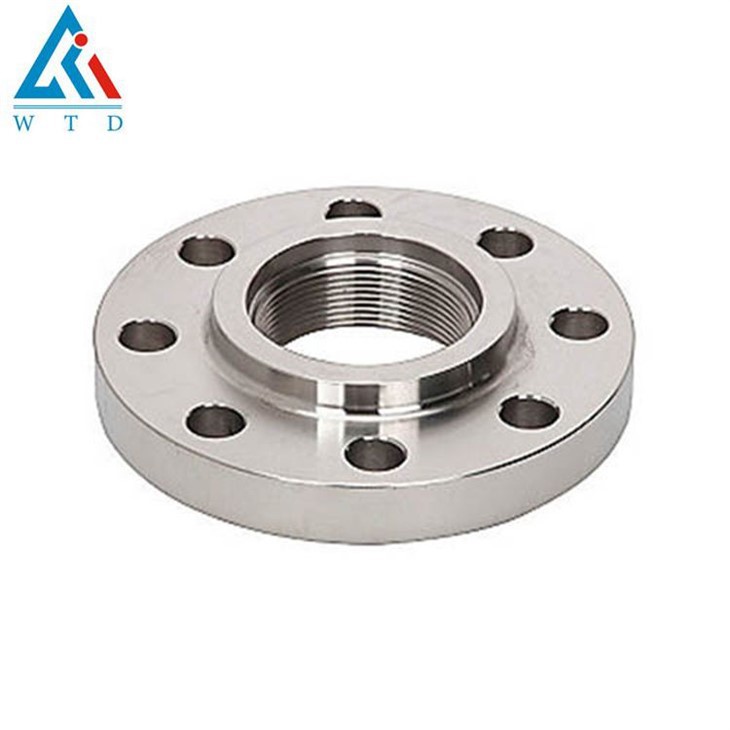
Grade 2 Titanium Threaded Flanges
Name:Grade 2 Titanium Threaded Flanges
Standard: Ansi B16.5
Size:1/2" to 24"
Moq:1pc

Titanium spectacle blind flange
The Spectacle Blind Flange is widely used in many industries, including water conservation, electric power, power stations, pipeline fittings, industry, pressure vessels, chemical plants, shipyards, pharmaceuticals, and so on.The Spectacle Blind Flange has better sealing performance. It is commonly used as a reliable means of isolation in systems that require complete isolation.
What is Titanium Forged Ring?
The process for Titanium forged rings are usually made by heating a titanium ingot, forging it after it reaches a certain temperature, then forging the core through a die, then processing it on a ring rolling machine to a rough size, and finally turning it into a finished product.
Benefits of Titanium Forged Ring
Titanium forged rings are lightweight
half weight of steel,density is 4.51 g/cm3
Titanium forged rings are Corrosion resistance
The titanium surface is easy to form a dense and stable oxide film, which has a strong tendency to passivate and has strong corrosion resistance. It is much better than stainless steel in terms of corrosion resistance to hydrochloric acid and sulfuric acid.
Titanium forged rings are resistant to high and low temperatures
Titanium can be used for a long time at 600℃ and can maintain good ductility and toughness at -196℃ to -253℃.
Titanium forged rings are Low thermal conductivity
The thermal conductivity of titanium is about 1/4 of nickel, 1/5 of iron, and 1/14 of aluminum.
Titanium forged rings are non-magnetic
Titanium is non-magnetic and will not be magnetized in a magnetic field. It is used in military submarines, aircraft, etc. and cannot be detected by radar.
Titanium forged rings are non-toxic
Titanium is non-toxic and has good compatibility with human blood and tissues, so it can be used in medical applications.
Types of Titanium Forged Ring
Commercially pure titanium rings (ti-999)
Commercially Pure Titanium or CP is an excellent choice for those looking for a natural look. This grade of titanium is the purest form, containing no other metals. Making it ideal for those with sensitive skin or prone to skin irritation.
Aircraft grade titanium rings (ti-6/4)
Aircraft-grade titanium is an alloy used in the aerospace industry due to its exceptional strength and durability. This grade of titanium is an alloy made of 90% titanium, 6% aluminum, and 4% vanadium, which gives it a high level of strength and makes it resistant to corrosion. In fact, aircraft-grade titanium is about three times stronger than basic commercially pure titanium and will resist wearing to a much greater extent.
Aircraft-grade titanium rings are strong and durable, making them ideal for those looking for a ring that can withstand the rigors of everyday wear. They're also corrosion-resistant, so you don't have to worry about your ring losing its shine over time.
Extra-hard titanium rings (ti-6/6/2)
If you're looking for a titanium ring that is extra hard and durable, then Ti-6/6/2 is a perfect choice. This grade has 86% titanium, 6% aluminum, 6% vanadium, and 2% tin, which makes it a robust and durable option. The extra-hard titanium is a solid and durable option with a tensile strength of up to 180,000 psi and a Brinell hardness value of 389. In addition, it is 130% stronger than Aircraft Grade Titanium, making it the best choice for tension set rings.
Extra-Hard Titanium offers the highest resistance to denting and bending, which is ideal for those looking for a ring that will withstand the most challenging conditions. So whether you're an athlete or someone who works with their hands, Ti-6/6/2 is a perfect choice.
Process of Titanium Forged Ring
Titanium rings can be made using a variety of methods, including casting and hardworking processes. Here are some common methods used to make titanium rings:
Casting: Titanium rings can be made through a process called casting, where molten titanium is poured into a mold to create the desired ring shape. This method is commonly used for creating intricate designs and shapes that may be difficult to achieve through other methods.
Machining: Titanium rings can also be made by machining a solid piece of titanium into the desired ring shape. This process involves cutting, drilling, and shaping the titanium using specialized tools and machinery. Machining is often used for creating simple and sleek designs.
Sintering: In this process, titanium powder is compressed into a mold and then heated to a temperature where the particles bond together. This method is often used for creating titanium rings with unique textures or patterns.
Forging: Forging involves shaping the titanium by applying pressure and heat to deform it into the desired shape. This method is commonly used for creating strong and durable titanium rings
Combination of methods: Sometimes, a combination of different methods such as casting, machining, and forging may be used to create a titanium ring with specific features and designs.
Have your titanium ring cleaned and inspected
Regular cleaning and inspection are essential for maintaining your ring's appearance and integrity. While titanium is a strong material, it can still accumulate dirt and grime over time. Use a soft toothbrush, mild soap, and warm water to clean your ring. Then, gently scrub the ring, paying attention to any grooves or engravings.
Safe storage habits
When you're not wearing your titanium wedding ring, it's essential to store it safely. A secure jewelry box or a small, soft pouch is ideal for protecting your ring from scratches or other damage. Additionally, if you're traveling, make sure to keep your ring in a safe place, such as a hotel safe or a locked suitcase. Good storage habits will help ensure your ring stays safe and sound, even when not worn.
If you're ever unsure, don't wear your titanium ring
There may be times when you're unsure whether it's safe to wear your titanium wedding ring. In these situations, it's best to err on the side of caution and leave your band at home. Typical scenarios where you might want to avoid wearing your ring include working with heavy machinery, engaging in sports or outdoor activities, or handling harsh chemicals. By being mindful of when you wear your band, you'll reduce the risk of damaging or losing it.
Never wear your ring in the pool or the ocean
This bears emphasis: never wear your titanium ring in an open body of water. Although titanium is corrosion-resistant, removing your ring before swimming is still a good idea. Cold water can cause your fingers to shrink, making it easy for your band to slip off your finger and sink to the bottom. Your ring will likely be lost, even in shallow water, as it gets swept up in the current.
Titanium in the Beginning
Titanium is a silvery-gray metal and element with the symbol Ti. As a metal, titanium has become renowned for its excessive strength-to-weight ratio, which is very light but also incredibly durable. Its notably extreme melting factor makes it beneficial as an element for jewelry making, and it is naturally resistant to corrosion by seawater, salt, and chlorine.
Titanium was first located in Cornwall, a coastal city in southern Great Britain, by William Gregor in 1791. Martin Heinrich Klaproth named it after the Titans of Greek mythology. Titanium can be mined from intrusive crystalline rocks or weathered rocks, but more than half of the titanium used today comes from unconsolidated deposits referred to as coastal placer deposits. In its pure, unalloyed condition, titanium is as strong as several variants of steel, yet it can also retain a much lighter density.
Although this metal was discovered in 1790, its true potential was discovered only around World War II. To turn the tide of the war, the United States started utilizing this metal. The country trusted titanium in the construction and launch of new aircraft. The metal's invincibility to nature and its lightness made it ideal for vehicles. Many say that titanium won the war. The European seas were conquered by these newly invented Allie ships thanks to the super metal. This American-reinforced metal eventually defeated German engineering. It was titanium that allowed the Allies to win air and sea victories, with a lighter and stronger version of the previously- used steel. NASA has also used titanium in the creation of the International Space Station.
So, when you're wearing a piece of titanium jewelry, you are giving your hand the strength of a Mach 3 or US Navy ship!
Titanium's History in Jewelry
Titanium's use in jewelry, however, is even more modern. An effective method for turning titanium ore into a usable metal form for jewelry making has only been around for a few decades. The first reports of titanium jewelry being sold were recorded around the early 1990s. Unlike gold and silver, which had been in use since 4000 BC, titanium found its strength in the twentieth century.
Titanium may be combined with numerous metals to create an alloy, making it even more desirable. It can be alloyed with iron and aluminum, amongst other metals, to supply strong, lightweight alloys. Although titanium is a new metal used to make wedding bands, ID bracelets, and necklaces, it is starting to appear in designer jewelry brands like Tiffany & Co. and David Yurman.
Owning titanium is not only a stylish investment but it's one you will carry for life. Virtually indestructible, titanium rings are becoming more and more popular in the world of fashion. One of the many reasons men and women alike are turning to this versatile metal is because of its durable properties. Many of the traditional precious metals do not stand up to severe wear and tear as titanium does. If you're hitting the weights often or getting your hands dirty at work, titanium rings are a fantastic choice to stand up to extreme use. Here at Titanium Style we recognize the need for your jewelry to stand up to your lifestyle, so there is no need to adjust your routine or the way you go about your day.
With a titanium ring, there is no fear of damage, which is part of the appeal to those who are in mechanical or industrial fields. Typically constructed of about 90-95% titanium, these rings can withstand severe conditions and the occasional ding from your work tools. They hold their sheen well and are much more resistant to tarnish than gold or silver rings. Engineers or laboratory technicians who may be dealing with corrosive materials or hazardous machinery are just a few professions that have switched to titanium rings. Perfect for those sporting a wedding band and typically don't like to remove them.
Our Factory
WTD Company has been deeply engaged in the non-ferrous metals industry for many years and has accumulated rich production experience, especially in the processing of new titanium materials such as TA15, which is at the forefront of the world.


FAQ
Hot Tags: titanium forged ring, suppliers, manufacturers, factory, customized, wholesale, buy, price, discount, 2.5 Inch Titanium Exhuast Pipe, , Grade 5 Titanium Bar, Titanium Raw Material
You Might Also Like


Send Inquiry