

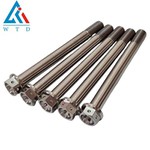


Titanium Forging Parts
Company Profile
(Here in after referred to as WTD Company) Is located in Baoji (Titanium Valley) in western China, a non-ferrous metal processing and sales of high-tech enterprises. The company focuses on the production and sales of titanium, zirconium, tantalum, nickel, tungsten, molybdenum and other non-ferrous metal materials. The products are exported to the United States, Britain, Germany, Italy, Japan, South Korea, Canada, Australia, Chile and other countries, well received by customers.
Why Choose Us
High quality
Each batch of goods has a corresponding quality inspection report to solve your concerns about product quality.
Professional solution
With rich experience and one-to-one service, we can help you choose products and answer technical questions.
Good services
Customer service will update you the logistics information of the goods in time to ensure that the goods are delivered in time.
Quick transportation
We cooperate with professional shipping, air transportation and express logistics companies to provide you with the best and fastest transportation solutions.


What Is DN100 Titanium Plate Flange ?
DN100 titanium plate flange is a part made of non-ferrous metal titanium or titanium alloy to connect pipes and pipes, connected to the end of the pipe. There are holes in the DN100 titanium plate flange, and bolts are used to tightly connect the two flanges. There are gaskets between the flanges. Flange pipe fittings refer to pipe fittings with flanges (flanges or joints). They can be made by casting; flange joints consist of a pair of flanges, gaskets and several bolts and nuts. The gasket is placed between the sealing surfaces of the two flanges. After tightening the nuts, the specific pressure of the gasket surface reaches a certain value, causing deformation, filling the uneven parts of the sealing surface to ensure a tight connection.

Advantages of DN100 Titanium Plate Flange
Titanium flanges are very strong
Only 60% as dense as steel, titanium alloy has a density of roughly 4.51g/cm3. Pure titanium is quite similar in density to regular steel. Some extremely strong titanium alloys are stronger than many alloy structural steels. As a result, titanium alloy has a substantially higher specific strength (strength/density) than other metal structural materials.
High thermal strength is a property of titanium flange
Titanium alloy can operate for extended periods at 450–500 °C while still maintaining the needed strength at mild temperatures.
Flange made of titanium resists corrosion well
The corrosion resistance of titanium alloy is much better than that of stainless steel when used in humid environments and seawater environments. It has strong resistance to pitting corrosion, acid corrosion, and stress corrosion, as well as excellent corrosion resistance to alkali, chloride, chlorine organic materials, nitric acid, sulfuric acid, and other acids.
Titanium flange performs well at low temperatures
Low and ultra-low temperatures allow titanium alloy to preserve its mechanical characteristics. Titanium alloys like TA7, which have excellent low-temperature characteristics and relatively little interstitial material, can maintain some plasticity to – 253 °C. Titanium alloy is a crucial low-temperature structural material as a result.
Types of DN100 Titanium Plate Flange
Neck welding flange
A Neck Welding Flange, commonly known as a Weld Neck Flange, features a prolonged tapered neck that ensures a seamless transition from the pipe to the flange. Primarily designed for high-pressure applications, this flange is welded to the pipe, enhancing structural integrity and preventing leakage.
Flat weld neck flange
Similar to the Neck Welding Flange, the Flat Weld Neck Flange possesses a flat face on the neck. This design is particularly suitable for applications where a flat surface is required for gasket sealing, ensuring efficient and reliable joint connections.
Flange cover
A Flange Cover serves the crucial purpose of safeguarding the flange and joint from environmental elements, corrosion, and potential damage. These covers are crafted to fit securely over the flange, providing an added layer of protection.
Clamp-connected flange
Also known as a Lap Joint Flange, the Clamp-Connected Flange is ingeniously designed to slide over the pipe and then be rotated to align with the bolt holes of the companion flange. This feature facilitates easy alignment and dismantling of the piping system when needed.
ANSI weld neck flange
Adhering to standards set by the American National Standards Institute (ANSI), ANSI Weld Neck Flanges are commonly employed in industries following ANSI specifications for their piping systems. These flanges ensure compliance with recognized standards.
Rubber expansion joint flange
A Rubber Expansion Joint Flange is associated with flexible joints that provide critical functions such as vibration isolation, noise reduction, and compensation for thermal expansion or contraction in piping systems. These flanges often incorporate rubber or elastomer materials for enhanced flexibility.
Plate flat flange
The Plate Flat Flange is a flat-faced flange without a raised neck. Its suitability lies in applications where precise bolt alignment and ease of assembly are essential factors for successful and efficient joint connections.
Customized flange
Customized Flanges are precisely tailored to meet specific requirements defined by the client or application. These flanges are designed based on unique dimensions, features, and standards beyond the scope of standard flange types, ensuring a perfect fit for specialized needs.
Medical and pharmaceutical applications
The medical and pharmaceutical industries prioritize materials that are biocompatible and resistant to chemicals and bodily fluids. DN100 steel plate alloy meet these criteria, making them suitable for applications in medical devices, implants, and pharmaceutical manufacturing equipment.
Aviation and aerospace industry
DN100 steel plate alloy is of great importance in the manufacture of aircraft and aerospace equipment due to its high strength, light weight, and extreme temperature resistance. They are used in fuel systems, hydraulic systems and engine parts.
Chemical processing
DN100 Steel plate for wide use in chemical plants and sintering plants to process corrosive chemicals. They have excellent resistance to acids, alkali and other corrosive substances, ensuring safe operation.
Petroleum and natural gas industry
DN100 steel plate is used in offshore drilling wells, subsea pipelines and processing facilities, which are subject to high pressure, corrosive environment, seawater exposure and other adverse conditions. The corrosion resistance and strength of DN100 steel plate makes it an ideal choice for these applications.
Power generation
DN100 steel plate for power plants, including nuclear, fossil fuel and renewable energy facilities. They can withstand high temperatures, pressure differences and corrosive environments to ensure the integrity of the storage system.
Marine industry
DN100 steel plate for marine use because they have corrosion resistance in saline water environment. They are used in shipbuilding, desalination plants and offshore wind farms.
How to choose DN100 Titanium Plate Flange
Flange types and standards
Titanium flanges come in various types, each designed for specific applications. The common types include slip-on flanges, weld neck flanges, socket weld flanges, and blind flanges.Additionally, titanium flanges adhere to international standards set by organizations like the American Society of Mechanical Engineers (ASME) and the American Society for Testing and Materials (ASTM).
Consideration for welding
Welding titanium requires specialized techniques due to the metal’s reactive nature at high temperatures. When choosing a titanium flange, it’s crucial to consider the welding process that will be employed.
Corrosion resistance in specific environments
Different industries expose piping systems to varying levels of corrosive environments. When choosing a titanium flange, it’s important to assess the specific corrosive factors that the flange will encounter. Titanium’s corrosion resistance is exceptional, but its performance may still vary based on factors such as the type of corrosive substance, temperature, and pressure.
Temperature and pressure considerations
Titanium’s ability to withstand high temperatures and pressures is a major advantage. However, the specific temperature and pressure conditions in your application should be thoroughly evaluated.
Compatibility with piping materials
Compatibility between the titanium flange and the piping materials is another crucial consideration. The flange material should be compatible with the materials of the pipes, valves, and other components it will be connected to. Incompatibility can lead to galvanic corrosion, which can compromise the integrity of the entire system.
How to Install DN100 Titanium Plate Flange
Proper installation
Installing DN100 titanium plate flanges in harsh environments requires proper preparation for optimal performance and service life. It is important to use the correct grade of titanium alloy, which must be able to resist environmental corrosion. A good surface finish is also essential and can be achieved by machining or sandblasting. A calibrated torque wrench should be used to apply the appropriate tightening torque throughout the system to achieve a reliable connection. During maintenance, carefully inspect the DN100 titanium plate flange for any signs of corrosion or deformation due to vibration or shock waves that may occur during operation. If necessary, repair the damage by first cleaning the exposed surface with sandpaper and then recoating with a suitable protective material such as paint or epoxy coating. Regular inspection of bolts and nuts and applying proper lubrication help ensure continued firm tightening during long-term operation under difficult conditions.
Preventing contamination
DN100 titanium plate flanges can provide optimal performance and service life when they are properly installed and maintained in harsh environments. First, to install the DN100 titanium plate flange, use bolts with high-grade elastic rubber washers to fasten it to the pipe to ensure a tight connection. Next, apply sealant to the bolt threads to prevent leaks. In addition, use anti-corrosion paint on exposed titanium surfaces to further prevent moisture and other contaminants. When maintaining DN100 titanium plate flanges, regularly check for signs of corrosion or wear and replace any components as necessary to maintain optimal performance. Finally, take steps to prevent contamination from external sources such as air or water, creating a barrier between the working environment and the outside of the system as much as possible. These steps will help you successfully install and maintain optimal performance in harsh environments.
Regular maintenance
Regular maintenance of DN100 titanium plate flanges can extend their service life and ensure optimal performance. Routine inspections must be performed to check for any signs of corrosion, leaks or damage. Any problems must be addressed promptly to prevent further damage. It is also recommended to regularly clean the flanges with non-abrasive cleaners and avoid using harsh chemicals that can degrade titanium.
Work with experts
Finally, working with DN100 titanium plate flange experts is essential for proper installation, maintenance and repair. Experts can ensure that the flanges are properly installed and properly maintained, thereby maximizing their performance and service life. Additionally, experts can provide valuable advice on choosing the right grade of titanium and selecting the right accessories to enhance performance.
TA2 Titanium Jacketed Ball Valve have gained popularity in various industrial applications due to their excellent corrosion resistance, superior mechanical strength, and long-term durability. As a valve manufacturing material, titanium provides several advantages that make it a highly desirable choice compared to other materials, such as steel, copper, and iron. Titanium is lightweight with high strength-to-weight ratio, making it ideal for applications that require high-strength materials with minimal weight. It is also exceptionally resistant to corrosion, even in harsh environments. Making it an excellent choice for industries like chemical processing, petrochemicals, and power generation, among others.

Advantages of TA2 Titanium Jacketed Ball Valve
Titanium construction
TA2 titanium jacketed ball valves are largely made of titanium, a metal that is strong, lightweight, and corrosion-resistant. Titanium is extremely durable and resistant to corrosion, chemicals, and severe conditions.
Full bore design
This design reduces flow constraints, pressure drop, and turbulence, enabling for efficient fluid or gas flow.TA2 titanium jacketed ball valves are normally full bore, which means the internal diameter of the valve is the same as the pipe’s diameter.
Two-way flow control
TA2 titanium jacketed ball valves provide reversible flow control, which allows fluid or gas to travel through the valve in both directions. This feature allows for greater flexibility in system setups and easy control of flow direction.
Various end connections
The type of end connection used is determined by the application and installation requirements.TA2 titanium jacketed ball valves are offered with a variety of end connectors to accommodate a variety of pipe systems.Threaded, flanged, socket weld, and butt weld connectors are all common forms of end connections.
Wide temperature and pressure range
TA2 titanium jacketed ball valves are resistant to a broad variety of temperatures and pressures. They can be used in both low-temperature cryogenic applications and high-temperature procedures, making them adaptable to a wide range of industrial conditions.
Application of TA2 Titanium Jacketed Ball Valve
Aerospace and defense
TA2 Titanium Jacketed Ball Valves are used in aircraft engines, missile systems, and spacecraft, where lightweight materials with high strength and corrosion resistance are essential.
Chemical processing
In chemical plants and refineries, TA2 Titanium Jacketed Ball Valves are employed in corrosive environments for handling acids, alkalis, and other aggressive chemicals.
Marine and offshore
Due to their resistance to corrosion in seawater environments, TA2 Titanium Jacketed Ball Valves are utilized in marine and offshore applications, including seawater desalination plants, offshore oil rigs, and shipboard systems.
Medical devices
TA2 Titanium Jacketed Ball Valves are used in medical devices and implants due to their biocompatibility, corrosion resistance, and strength-to-weight ratio.
Component of TA2 Titanium Jacketed Ball Valve
Valve body
The TA2 titanium jacketed ball valve body is the main housing of the TA2 titanium jacketed ball valve and it contains the ball, seats, and other components.
Handle
The handle is used to manually rotate the ball to control the flow of fluid through the valve.
Stem
The stem connects the handle to the ball and transmits the rotation of the handle to the ball.
Gland nut
The gland nut compresses a packing material around the stem to prevent leakage.
Inlet port
The inlet port is the passage through which fluid enters the valve.
Outlet port
The outlet port is the passage through which fluid exits the valve.
Rotary ball
The ball is arguably the most important component of the TA2 titanium jacketed ball valvesince it controls the flow of fluid. When the ball is in line with the flow path, fluid can pass through the valve. When the ball is rotated 90 degrees, the flow path is blocked.
Thrust washer
The thrust washer reduces friction between the ball and the valve body, which can improve the performance and lifespan of the valve.
Joint gasket
The joint gasket provides a seal between the valve body and the piping to prevent leakage.
Seats
The seats are located on either side of the ball and provide a sealing surface when the ball is rotated to the closed position, preventing fluid from passing through the valve.
Bonnet
The bonnet covers the stem and packing material and provides access for maintenance.
Actuator
The actuator is used to automate the valve and can be electric, pneumatic, or hydraulic. It rotates the ball in response to a control signal to control the flow of fluid through the valve.
Locking device
A locking device prevents unauthorized or accidental operation of the valve.
Stem extension
A stem extension allows the handle or actuator to be mounted further away from the valve body, which can be useful in hard-to-reach locations.
Stem protector
A stem protector protects the stem from damage or corrosion.
Cavity filler
A cavity filler is used to fill the cavity behind the ball in a full-port TA2 titanium jacketed ball valve, reducing the risk of fluid buildup and damage to the valve due to thermal expansion.
Drain valve
A drain valve allows fluid to be drained from the valve and piping system for maintenance or repair purposes.
How to Maintain TA2 Titanium Jacketed Ball Valve
Regular inspections
Just as a doctor would regularly check a patient's vital signs, inspect your TA2 titanium jacketed ball valve s regularly for any leaks and monitor operational performance. If a valve is leaking or not operating at its peak, it may be a sign that it requires maintenance or replacement.
01
Lubrication
Some TA2 titanium jacketed ball valve s may benefit from regular lubrication to ensure smooth operation. Always adhere to the manufacturer's instructions regarding the type and frequency of lubrication.
02
Seal replacement
As mentioned earlier, seals are often the first component to fail in a TA2 titanium jacketed ball valve . With a serviceable three-piece design, these can be replaced without having to remove the entire valve from the system, thus prolonging the valve's life.
03
Clearing obstructions
Just like how a blocked artery can cause health problems, a valve obstructed by debris or foreign particles can hamper flow and affect performance. Regular inspections and cleaning can help keep the valve free from obstructions.
04
Follow the manufacturer's specifications
Each valve comes with a unique set of preventive maintenance instructions from the manufacturer. It's important to follow these specifications to ensure the valve's optimal performance and longevity.
05
A TA2 titanium jacketed ball valve is a device that allows a fluid to flow in one direction. These valves have two ports: one for media input and one for media output. Since they only allow the material to flow in one direction, they are also known as check valves. A TA2 titanium jacketed ball valve is a type of shut-off valve that uses a ball with a hollow section to regulate the flow of liquids or gases. By rotating the ball a quarter of a turn around its axis, the medium can flow through or be blocked. They have a long service life and provide an effective seal even when the valve is not in use, making them one of the most durable pipeline valves you can use. A wrench or lever that is manually twisted by the user is the easiest way to operate a TA2 titanium jacketed ball valve. To open and close the valve, apply torque to the lever arm and move it 90 degrees clockwise or counterclockwise. When the lever arm is parallel to the pipe, it means that the valve is open. However, when the lever arm is perpendicular to the pipe, the valve closes. The flow rate of the system is used to control the check valve. Once the system reaches the opening pressure or minimum upstream pressure required for the valve to work, the disc rises and allows the fluid to pass through. If the fluid pressure drops or the flow direction begins to reverse, the disc will automatically stop the valve to stop the fluid from passing through. As a result, backflow is reduced. Applications that require a TA2 titanium jacketed ball valves are the most important limiting factor. For low-pressure, low-temperature applications, a PVC TA2 titanium jacketed ball valve may be sufficient, but a stainless steel TA2 titanium jacketed ball valve may be required to block the flow of hot or high-pressure material. Not all TA2 titanium jacketed ball valves need to be manually actuated. Some valves, such as motorized TA2 titanium jacketed ball valve s, open and close as current passes through.
How to Choose the TA2 Titanium Jacketed Ball Valve Correctly
TA2 titanium jacketed ball valve size and end connections: Select a TA2 titanium jacketed ball valve size compatible with your pipeline, and ensure the end connections match your existing system.
Material selection: Evaluate the compatibility of TA2 titanium jacketed ball valve materials with the fluid being handled and the environmental conditions.
Pressure and temperature ratings: Ensure that the selected ball TA2 titanium jacketed ball valve can withstand the pressure and temperature requirements of your application.
Flow control requirements: Determine the degree of flow control precision needed and choose the appropriate ball TA2 titanium jacketed ball valve type (full bore, v-port, etc.).
Actuation type: Consider the ease of operation and the required actuation mechanism (manual, electric, or pneumatic).
Our Factroy
(Here in after referred to as WTD Company) Is located in Baoji (Titanium Valley) in western China, a non-ferrous metal processing and sales of high-tech enterprises. The company focuses on the production and sales of titanium, zirconium, tantalum, nickel, tungsten, molybdenum and other non-ferrous metal materials. The products are exported to the United States, Britain, Germany, Italy, Japan, South Korea, Canada, Australia, Chile and other countries, well received by customers.


FAQ