


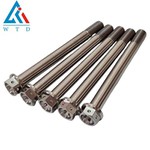


Titanium Ingot
Baoji Wantaida Titanium Material Co., Ltd. is located in Baoji in western China, a non-ferrous metal processing and sales of high-tech enterprises. The company focuses on the production and sales of titanium, zirconium, tantalum, nickel, tungsten, molybdenum and other non-ferrous metal materials. The products are exported to the United States, Britain, Germany, Italy, Japan, South Korea, Canada, Australia, Chile and other countries, well received by customers.


Why Choose Us?
High quality
Each batch of goods has a corresponding quality inspection report to solve your concerns about product quality.
Professional solution
With rich experience and one-to-one service, we can help you choose products and answer technical questions.
Good services
Customer service will update you the logistics information of the goods in time to ensure that the goods are delivered in time.
Quick transportation
We cooperate with professional shipping, air transportation and express logistics companies to provide you with the best and fastest transportation solutions.
What is Titanium Ingot?
Titanium ingot is created in a smelter by putting titanium ore and planks inside it. Titanium ingots are considered more powerful and efficient as compared to iron counterparts and play a prominent role in engineering and construction work. Their sturdiness, precision and superior performance make them ideal for multiple uses, be it industrial or commercial. These titanium ingots are made through forged technique and are rustproof. They are available in distinct varieties perfect for different project sizes and types.
Benefits of Titanium Ingot
Resistance to corrosion
When exposed to air, a thin layer of oxide forms on the surface of titanium. This layer is very difficult for most materials to penetrate. As such, titanium demonstrates fantastic resistance to corrosion – and will not suffer adverse changes (i.e. pitting, cracking) due to corrosive substances.
Whether it’s used indoors or outdoors, it will last for many years – making it an excellent choice for buildings and marine applications, where it will be continuously exposed to seawater and rain.
Strength
One of the biggest advantages of titanium is its strength. Not only is it one of the strongest metals on the planet, it also has the highest strength-to-density ratio of any metallic element on the periodic table. This makes it a popular option in many professions.
What’s more, as it has a low density, titanium is also incredibly lightweight.
To put this into perspective, titanium has a specific gravity of 4.5 – which is approximately 40% lighter than an equal amount of copper and 60% lighter than an equal amount of iron. This is one of the reasons why it’s often used in the aerospace industry and to create structural frames.
Non-toxic
Metals such as iron, steel and aluminium can all be toxic to humans.
By contrast, titanium is bio-compatible. It is completely non-toxic to both humans and animals (partially due to the fact that it’s resistant to corrosion) – and, as a result, can be safely implanted into the body without causing an adverse reaction. This is why titanium is commonly used within the medical industry (e.g. to permanently strengthen broken bones) and for dental implants.
Low thermal expansion
Titanium has a low coefficient of thermal expansion.
Essentially this means, compared to most other manufacturing materials, it will not expand and contract anywhere near as much under extreme temperatures. In fact, it expands approximately 50% less than steel, and therefore provides much greater structural stability.
This feature is especially useful if creating a superstructure that requires a rigid yet lightweight framework. It also makes titanium suitable for building applications where fire safety is paramount.
High melting point
This is one of the key benefits of titanium. It demonstrates an exceptionally high melting point (around 1668°C) and, as such, is perfect for use in high-temperature applications. For example, it’s the metal of choice for foundries, turbine jet engines and even some satellites.
Excellent fabrication possibilities
Despite its strength, titanium is a relatively soft and ductile refractory metal. As such, it can be easily machined and fabricated to create a diverse range of metal parts and components. Due to its resistance to oxidisation, it can also be open-air and seam welded, without the need for any type of flux agent – and the weld zone will not require any form of additional protection.
Types of Titanium Ingot
Commercially pure titanium (CP Titanium)
These ingots have a high degree of purity, typically containing between 99.0 and 99.99% titanium. CP titanium is graded from Grade 1 to Grade 4, with Grade 1 being the most ductile and Grade 4 the least. It is widely used in applications that do not require high strength-to-weight ratios but need excellent corrosion resistance and formability.
Titanium alloys
The difference between pure titanium and alloys is that an alloy is made up of titanium and other metals. The reason why titanium is mixed with other elements is to provide additional strength, flexibility and malleability.
Titanium ingots used for aerospace industry
Titanium ingots are a cornerstone in aerospace engineering, employed in the manufacturing of aircraft engines and components. The exceptional strength-to-weight ratio of titanium makes it an ideal choice, contributing to the overall efficiency and performance of aircraft. From structural elements to critical components, titanium ingots are instrumental in ensuring the reliability and safety of aerospace vehicles.
Titanium ingots used for chemical equipment manufacturing
In the realm of chemical processing, titanium ingots find extensive use in manufacturing crucial components such as reactors, pipelines, heat exchangers, and valves. The corrosion resistance of titanium makes it particularly well-suited for handling corrosive chemicals, ensuring the longevity and reliability of equipment in chemical plants.
Titanium ingots used for shipbuilding
Titanium ingots play a significant role in shipbuilding, contributing to the construction of ship hulls. The lightweight nature of titanium aids in enhancing fuel efficiency and overall performance, making it a preferred material for naval and commercial vessels alike. The corrosion resistance of titanium is especially beneficial in the harsh marine environment.
Titanium ingots used for medical field
Titanium ingots are a cornerstone in the medical field, serving as the primary material for manufacturing medical implants and artificial bones. The biocompatibility of titanium makes it an ideal choice for implants, ensuring minimal risk of rejection by the human body. From orthopedic implants to dental prosthetics, titanium ingots contribute to advancements in medical science.
Titanium ingots used for sports equipment and consumer goods
Titanium's unique combination of strength and lightness makes it an ideal material for manufacturing sports equipment and various consumer goods. From bicycle frames to golf clubs, titanium ingots enable the production of high-performance and durable products. In consumer goods, titanium contributes to the creation of stylish and long-lasting items such as watches, jewelry, and electronic gadgets.
Titanium ingots used for energy industry
The energy industry benefits from the use of titanium ingots, particularly in applications requiring corrosion resistance and heat tolerance. Pure titanium is utilized in the manufacturing of heat exchangers and pipelines in petrochemical plants, thermal/nuclear power stations, and seawater desalination plants. The longevity and resilience of titanium ingots contribute to the efficiency and safety of energy infrastructure.
Titanium ingots used for high-end machinery manufacturing
Titanium ingots find a niche in high-end machinery manufacturing, where advanced mechanical components demand materials with exceptional strength and durability. From aerospace propulsion systems to cutting-edge industrial machinery, titanium ingots contribute to the creation of components that can withstand extreme conditions and deliver superior performance.
Process of Titanium Ingot
The conversion of purified titanium sponge to a form useful for structural purposes involves several steps. Consolidation into titanium ingot is performed in a vacuum or argon environment by the consumable-electrode arc-melting process. Sponge, alloying elements, and in some cases recycled scrap are first mechanically compacted and then welded into a long, cylindrical electrode. The electrode is melted vertically into a water-cooled copper crucible by passing an electric current through it. To ensure uniform distribution of alloying elements, this primary ingot is remelted at least once in a similar manner. Ingots weigh between 4 and 10 tons and are up to 1,050 millimetres (42 inches) in diameter.
Cold-hearth melting is an alternate consolidation process that is conducted inside an argon or vacuum chamber containing a water-cooled, horizontal copper crucible. Heating is accomplished by multiple electron-beam or by argon/helium plasma torches. The molten metal flows in a horizontal path over the lip of the hearth into a suitably shaped, water-cooled copper mold. The cold-hearth process is well suited to separating high-density contaminants, which settle to the bottom of the hearth. For this reason, it is used primarily to recycle titanium scrap, which can contain carbide tool bits left over from machining operations.
What Should Be Considered to Buy Titanium Ingots
Grade of titanium ingots
One of the most important factors to consider when you buy titanium ingots is the grade of titanium. There are several grades available, each with its own unique properties and characteristics. The grade of titanium you choose will depend on the specific requirements of your application. Some common grades of titanium include Grade 1, Grade 2, Grade 5, and Grade 23. It is essential to research and understand the properties of each grade to make an informed decision.
Titanium ingots certification
When you buy titanium ingot, it is crucial to ensure that the material meets the necessary quality standards and specifications. Look for suppliers that provide certification for their titanium ingot for sale, such as ASTM International standards or ISO certifications. This will give you peace of mind knowing that the titanium ingots you are purchasing are of high quality and meet industry standards.
Titanium ingots supplier reputation
Choosing a reputable and reliable supplier is key to ensuring you are buying high-quality titanium ingots. Look for suppliers with a proven track record of delivering quality materials and excellent customer service. Reading customer reviews and testimonials can also provide valuable insight into the reputation of a supplier. Additionally, make sure to inquire about the supplier's experience in the industry and their ability to meet your specific requirements.
In 1791, a British clergyman, R. W. Gregor, found an unknown oxide in iron sand sampled from a sandy coastal beach. He named the oxide “menaccanite”. Titanium production dates back to this discovery. In 1795, a German chemist, M. H. Klaproth, found a new metal oxide in a rutile ore in Hungary. He named the metallic element “Titanium,” derived from the word “Titan” in Greek mythology. It was subsequently confirmed that titanium was identical to the element previously discovered by R. W. Gregor. At this stage, titanium oxide was separated from other oxides in iron sand or rutile ore; metallic titanium, however, could not be extracted by reducing titanium oxide. This was mainly due to the very strong chemical affinity between titanium and oxygen.
After the discovery of titanium by R. W. Gregor, numerous chemists attempted to extract metallic titanium, but with no success. The raw materials used in previous studies were oxide (TiO2), potassium hexafluoro-titanate (K2TiF6), titanium tetrachloride (TiCl4), and other titanium compounds.
In 1825, J. J. Berzelius reduced K2TiF6 with potassium metal and obtained titanium containing a large amount of nitride. In 1887, L. F. Nilson and O. Petterson succeeded in producing 95 pct pure titanium metal. They chlorinated TiO2 with chlorine (Cl2) gas under carbon monoxide (CO) gas to synthesize TiCl4 and then reduced the TiCl4 with sodium (Na) metal.
In 1910, M. A. Hunter succeeded in producing 99 pct pure titanium metal by reducing TiCl4 with sodium metal in a closed steel container. The reduction process that uses sodium metal as a reducing agent is currently termed as the “Hunter process” in honor of his achievement. The purity of the obtained titanium product excluding the gaseous elements was 99.9 pct. However, the titanium metal was brittle and not cold-workable because it was heavily contaminated with oxygen. After improving the impurity control methods during the reduction process, Hunter obtained cold-workable and high-purity titanium. The Hunter process was put to practical use in the 1950s and employed for large-scale production until 1993.
In 1923, Ruff and Brintzinger obtained 83 pct pure titanium metal by reducing TiO2 with calcium metal (Ca). W. Kroll, a Luxemburger metallurgist, obtained 98 pct pure titanium metal by using the same method. However, the titanium product was not hot-workable.
In 1925, A. E. van Arkel and J. H. de Boer succeeded in producing high-purity titanium metal through a disproportionation reaction and the pyrolysis of crude titanium iodides (TiIx). The oxygen concentration of the titanium product was very low, and the product was cold-workable. This method is termed the “iodide process” (or the van Arkel deBoer process). Despite its low productivity, the iodide process was employed to produce high-purity titanium for the semiconductor industry.
In 1940, W. Kroll developed a titanium production process by reducing TiCl4 with magnesium (Mg) metal; the obtained titanium product was called “titanium sponge.” The US Bureau of Mines further developed this process for large-scale production. Titanium metal was first introduced to the market in 1948. In 1950, titanium sponge was produced using the same method on a laboratory scale in Japan. The reduction process of TiCl4 with magnesium metal is termed as the “Kroll process” and is the most commonly employed titanium smelting process.
Our Factory
WTD Company has been deeply engaged in the non-ferrous metals industry for many years and has accumulated rich production experience, especially in the processing of new titanium materials such as TA15, which is at the forefront of the world.


